The Venture Capital Reality
Deciding which path to take

SHARE THIS POST
For many years, the dream of receiving financing from a venture capital firm, whether from Silicon Valley, New York, or elsewhere, has captivated entrepreneurs and has been one of their central focuses. The image of plentiful venture capital readily available to creative entrepreneurs has been cultivated by the industry itself, as well as by the media. In reality, the image is a mirage or myth.
According to the American Venture Capital Association, the NVCA, in 2017, venture capital firms deployed an aggregate of $84.2 billion into 7,783 companies. While this fact on its face appears impressive, this represented the lowest number of companies since 2012 and includes both initial investments and follow-on investments. Indeed, the NVCA notes that overall there were fewer transactions taking place, that consummated transactions were at higher values and that companies were later stage, e.g., more mature. Specifically, 2017 saw a 6% decrease in terms of aggregate deals over 2016, yet a surge in total deal value of 16% year over year.
Start-Up.co reports that 565,000 start-up companies are launched monthly in the United States and that the average funding of these companies is $78,406, resulting in aggregate funding, whether seed, early, growth, or late stage, and irrespective of funding source, of $531 billion per annum. Startupshepherd.com estimates that, of these companies, only 1,400 per year receive funding from venture capital firms. For purposes of illustration only, based on the foregoing, if we assume that 90% of all start-up companies in a given year would for various reasons be ineligible for venture capital investment, venture capital firms would still only be financing approximately 0.2% of eligible start-up companies in any given year. Indeed, Forbes.com notes that “Less than 1% of startup businesses actually get their financing from VCs or angels.”
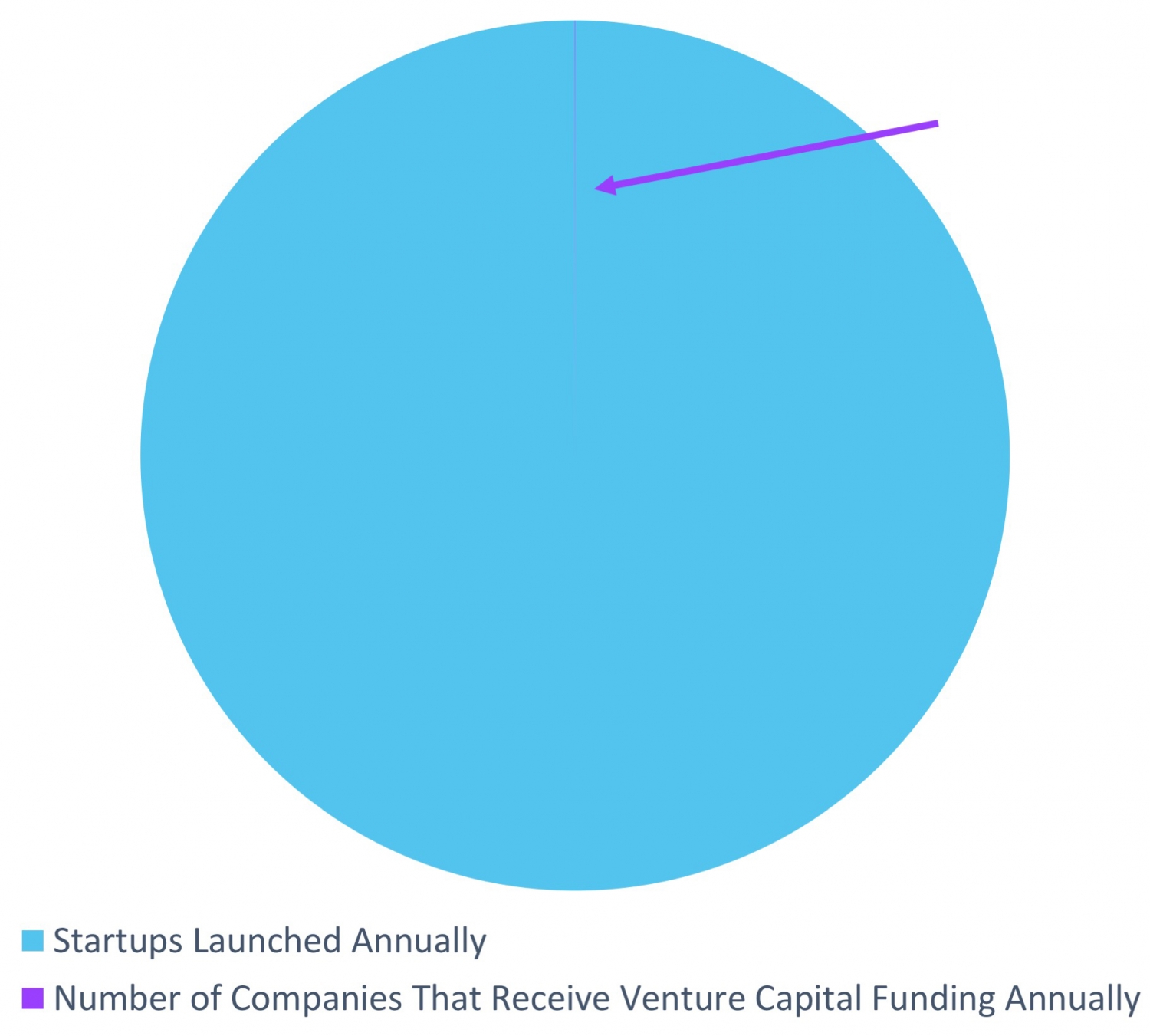
This chart illustrates the number of startups created annually relative to the number of companies that receive venture funding annually.
Even with respect to the firms that do receive venture capital investment, the question should be “Why are you raising venture capital in the first place, instead of another capital structure?” Forbes.com
Nothing mentioned in this post is intended to be offensive to venture capital firms. ClearThink maintains active relationships with many firms and has advised numerous clients with respect to venture capital transactions. That being said, all entrepreneurs (ourselves at ClearThink included) need to recognize and plan for the reality that, in all likelihood, venture capital will not be in their future.
So …
The companies not financed by venture capital firms are obtaining capital from somewhere. But where?
Each of these capital sources have distinct advantages and disadvantages.
Family and friends tend to be the least sensitive to valuation and investment terms and tend to be the most patient. That being said, failure of an investment to succeed can result in some awkward family and social gatherings.
Angels tend to be “accredited investors” under the Federal securities laws and provide capital and expertise to early stage companies. FundersandFounders.com estimates that the U.S. angel investor universe is approximately $21 billion, and that the average investment is approximately $37,000, as opposed to approximately $7.5 million for venture capital firms. As a result, angel investors make investments into far more companies annually than do venture capital firms. Score.org estimated that in 2014 there were approximately 268,000 angel investors in the United States.
Crowdfunding is a relatively recent structure created by the JOBS Act in 2012. In short, crowdfunding contemplates small investments by large numbers of generally unsophisticated individuals. According to the Securities and Exchange Commission, or SEC:
“With Regulation Crowdfunding, the general public now has the opportunity to participate in the early capital raising activities of start-up and early-stage businesses. Anyone can invest in a Regulation Crowdfunding offering. Because of the risks involved with this type of investing, however, you are limited in how much you can invest during any 12-month period in these transactions. The limitation on how much you can invest depends on your net worth and annual income.”
Crowdfunding has had a lackluster history to date. Based on the SEC’s whitepaper, of 187 crowdfundings conducted, 24 were withdrawn. The remaining 163 sought to raise an aggregate of $101.1 million, but raised in the aggregate only $8.1 million or 8% of the amount sought. Further, of 104 crowdfunding offerings with terminal dates during 2016, 18 were withdrawn and only 33% raised their minimum target amounts.
As a result of the large number of resulting stockholders following a successful crowdfunding, companies availing themselves of crowdfunding have experienced substantial difficulty in raising additional capital in subsequent rounds, and institutional investors have tended to shun companies which have raised money through crowdfunding. In addition, as crowdfunding investors are generally unsophisticated, valuations utilized in crowdfundings have tended to be over-inflated, resulting in substantial down-rounds subsequently, which has the potential to result in investor resentment and potentially litigation.
Strategic investors are companies in the same or related industries or markets to the company seeking capital. Transactions are often structured to establish an ongoing business relationship between the investor and the recipient of the capital and have tended to have higher valuations than pure venture financing, especially reflecting adjustment provisions built into venture capital documents.
Certain companies will appeal to private equity firms. Private equity is similar to venture capital, but focuses on later stage companies and can seek to provide control investments, minority investments, growth capital and other structures.
Investment banking firms aggressively seek emerging growth companies in search of financing. Depending upon, among other things, the company, its industry, and market conditions, transactions can be structured either as a private offering or a public offering, and can range from convertible debt securities to pure equity. These offerings are highly regulated, although institutional interest for the right company and the right transaction remain high, and certain funds, known as transitional capital funds, have specialized in providing private capital to companies seeking public offerings in the near future.
For companies which qualify, there is a large community of family offices and funds which specialize in the provision of private credit to companies which would not otherwise qualify for bank financing. These firms can be creative in structuring lines of credit, asset-backed lines, purchase order financing, equipment financing, and other forms of private credit.
SHARE THIS POST
References
Venture Monitor, Q4 2017, Pitchbook and National Venture Capital Association
Start-Up Funding, Infographic, Start-Up.co
The Real Odds of Getting Venture Capital for Your Startup, March 29, 2016, Jessica Smith, www.startupshepherd.com
Before You Raise Venture Capital You Need To Ask Yourself This Question, Forbes.com, December 3, 2018
Angels & Venture Capitalists Infographic, by Anna Vital, FundersandFounders.com
Angel vs Venture Infographic, ManagementParadise.com
U.S. Securities-Based Crowdfunding under Title III of the JOBS Act1, by Vladimir Ivanov and Anzhela Knyazeva, www.sec.gov/files/2017-03/RegCF_WhitePaper.pdf

 How To Finance Your M&A
Scroll to top
How To Finance Your M&A
Scroll to top