
Finding the right financing structure for an acquisition can sometimes be the most difficult part of the process. When structured correctly, a transaction will provide right amount of liquidity to the acquiree, without hindering the acquiror’s potential for future success and growth.

When contemplating mergers or acquisitions, whether buy-side or sell-side, it is important to select an advisor which understands proper transaction structure and execution, is highly experienced, and can assist in accessing financial and other partners necessary for a successful transaction.  ClearThink and its principals have extensive knowledge and experience as well as relationships with a vast network of potential partners.

Often, the structure of a merger or acquisition is driven by the acquiree’s need for liquidity at closing. While M&A transactions typically involve a combination of financing methods, these are the 6 most common types of M&A finance.

How to Finance Your Company’s Mergers and Acquisitions

Cash

Provided that an acquiror has the cash readily available, payment for an acquisition in cash is certainly the cleanest and least complicated alternative from the standpoint of both an acquiror and an acquiree.  In the case of cash acquisitions, acquirors usually require a “holdback” in which a certain amount of the cash purchase price is withheld until such time as the acquiror can be certain that representations and warranties are true and correct or covenants of the acquiree are satisfied.

Senior Debt

Debt financing allows an acquiror to purchase a company without diluting the equity in their company. If the acquiror and acquire on a pro forma basis, the acquiror, or the acquiree has positive cash flow, or will have positive cash flow within a short period of time, debt can be a great financing option. Debt financing for acquisitions is usually structured as a term loan, where the acquiror will be required to begin repayment of the lender after a set period of time.  For our smaller and more rapidly growing clients, we recommend private credit traditional banks. Private credit lenders are more flexible with regard to transaction structure, and far less covenant heavy than traditional banks. Learn more about private credit lenders: Private Credit: What Alternative Lenders Are Offering

Mezzanine

Mezzanine financing is similar to debt financing. The biggest difference between the two is that Mezzanine finance is subordinated debt. As a result, Mezzanine interest rates are generally significantly higher than senior debt financing rates. In addition, may mezzanine lenders require an equity component to increase their return. Mezzanine finance is ideal for companies that are acquiring a cash flowing business, but are not able to give a lender Senior position.

Stock

An exchange of shares is fairly straightforward. The acquiror gives the acquiree a certain number of shares in the acquiror’s company as payment for the acquisition.

The acquiree should be careful when receiving payment in shares for two reasons. First, depending on how the transaction is structured, payment in shares can result in what is known as phantom tax, which is tax liability without the receipt of cash compensation.  Second, unless the acquiror company is publicly traded, it will be very difficult for the acquiree to liquidate their shares. As a result, the acquiree may be stuck with a large tax liability, and no way to liquidate their shares.

Stock payment is also used to incentivize employees or management of the acquiree to continue to work at the acquiror company. Typically, an employee will receive stock options at certain milestones after the acquisition. These milestones are structured in a number of different ways, including periods of time or sales targets.

Public Offering

A public offering is similar to an exchange of shares in the sense that payment is received in the form of stock. The difference, however, is that a public offering provides liquidity to both companies. Once the acquiror has acquired the acquiree and commences trading, the holders of both companies have the ability to sell shares in the public market.

Typically, there will be a period of time anywhere from six months to two years during which the acquiree must hold their shares. This period of time can vary based on a number of factors. These factors include the number of shares, the amount of cash, if any, paid up front, as well the other types of payment involved. Generally, the larger the percentage of the transaction paid in stock, the shorter the amount of time the acquiree will have to hold the shares.

Revenue Share/Royalty/Earnout

Revenue share and earnout structures are rarely the sole compensation for the purchase of a company. Usually, a revenue share or earnout is part of a larger compensation package, such as shares or cash at the time of closing. Revenue share and earnout structures are used in situations where the acquiror wants to ensure that represented financial milestones will be satisfied over a significant period of time post-closing. 

The ClearThink Capital team members are experts at the design and execution of creative acquisition, financial, and other corporate transaction structures. We work with companies to determine the best transaction structure to fit their needs, help prepare the company and its materials for acquisition or financial partners, match them with the most appropriate partners, and work as their advisor throughout the entire process.

Is M&A in your company’s future? Let’s set up a call to discuss how we can help. Get in touch with our team below.

Perhaps the most important aspect of any corporate transaction, whether a private offering of securities, a public offering, a merger or acquisition or otherwise, is what is known as “due diligence”.

“Diligence is the mother of good fortune.” – Benjamin Disraeli

The Basics of Due Diligence

Due diligence requires the review of all material documents and other information with respect to a company in order to ensure that any disclosures which a company makes, whether in offering materials or an agreement, are true and correct and satisfies any applicable standard of liability.

What does “material” mean?

The Supreme Court has held that something is “material” if there is a substantial likelihood that it would be deemed important by a reasonable investor in making a decision to purchase or sell a company or its stock or as to how to vote their shares.

A due diligence review will inform you as to the material attributes of a company or person, including their commitments, contracts, and liabilities, their business, prospects, financial condition, and results of operations.

  • Does the company exist?
  • Who are the owners?
  • How does the business work?
  • Who are its customers?
  • How do you know that a company has the contracts it claims?
  • How do you know if the projected financial results are based upon accurate and reasonable assumptions?
  • What are the liabilities or contingencies?
  • The answer to these questions, as well as many more, lies with effective due diligence.

Due Diligence for Public and Private Securities Offerings

Securities offerings are governed federally by the Securities Act of 1933, as amended. Pursuant to Section 11 of such Act, as a general matter, if any disclosure with respect to an offering of securities contains an untrue statement of a material fact or omits to state a material fact required to be stated therein or necessary to make the statements therein not misleading, the issuer of such securities, the officers and directors of the issuer, partners in the issuer, the investment bankers conducting such offering, and professionals retained by the issuer with respect to such offering, are subject to liable for such material misstatements or omissions.

While there are no defenses to the foregoing available to the issuer and only limited defenses available to the members of the board or executive officers of the issuer, the other parties listed above may rely upon what is known as the “due diligence defense”.

The Act provides that it shall be a defense to such liability if such other party had, after reasonable investigation, e.g., a “due diligence review”, reasonable grounds to believe and did believe that the statements in such disclosure were true and that there were no omissions to state a material fact required to be stated therein or necessary to make the statements therein not misleading.

Due Diligence for Mergers and Acquisitions

In the context of mergers and acquisitions, due diligence serves the role of fact finding, disclosure checking, and confirmation, e.g., that the representations and warranties set forth in the operative transaction documents are true and correct.

While the standard of liability in this context can be modified by contract, a due diligence review ensures that the purchaser or purchasers are receiving what they believe to be correct.

Importance of Due Diligence

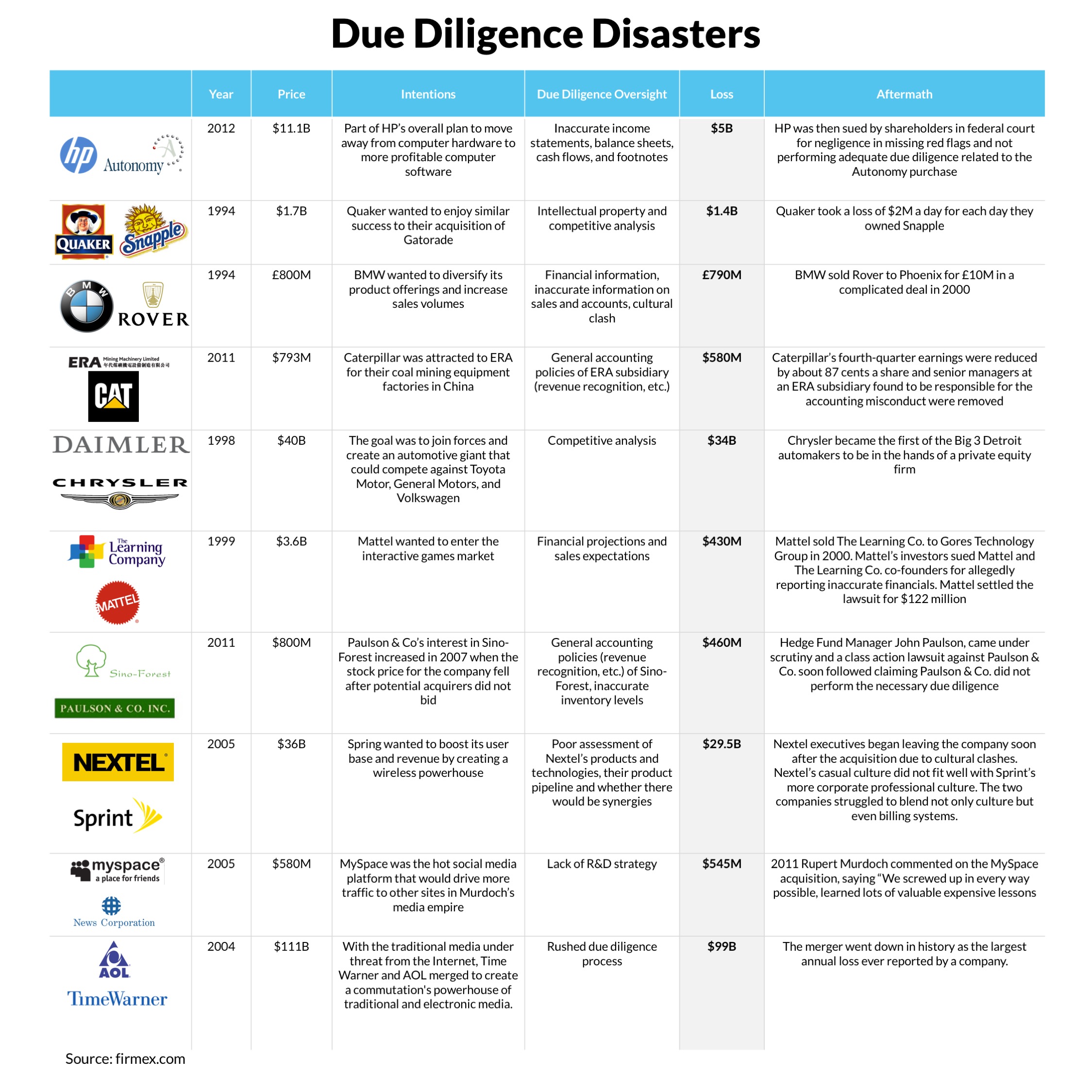
The failure to engage in a complete and effective due diligence process can be catastrophic and result in substantial litigation.

Below is a list describing some of the greatest due diligence failures of all times and some of the consequences that resulted.

ClearThink Capital’s Due Diligence Process

Any due diligence process is based upon organization: the company subject to the review will need to organize its material documents and descriptions of undocumented material facts so as to provide full disclosure in all material respects.

Although most companies can accomplish this process with little disruption, companies that have not kept complete and organized records and documents may be required to dedicate substantial time to establishing an organization process and adhering to the process.

ClearThink seeks to make the due diligence as easy and simple as possible and provides a form of initial due diligence request list that reflects the organization expected by transaction participants and provides a structure for the categorization of documents.

In order to expedite the transaction process and assure full disclosure, ClearThink does the following:

  • Dataroom: ClearThink will establish for each transaction an organized dataroom in the form expected by the transaction participants and corresponding to our initial due diligence request list.  ClearThink reviews and remediates the due diligence of its client in advance of disclosure to others
  • Report: ClearThink will review all due diligence materials provided by its client, as well as other parties to the contemplated transaction, will document its review, and will make suggestions regarding, and endeavor to assist with, remediation, amendments, or explanation required in order to provide full, fair and accurate disclosure
  • Gatekeeping: ClearThink will act as the gatekeeper to the dataroom, providing access only with the consent of the relevant parties, thereby minimizing the possibility of the compromise of sensitive data

As a philosophical matter, ClearThink is a strong proponent of full disclosure of both positive and negative information.  That being said, proper management of the due diligence process will assure that corrective measures are completed prior to disclosure to third parties, thereby maximizing the probability of a successful transaction.

ClearThink and its principals have extensive experience in the management of due diligence reviews, including reviews relating to 240 public offerings raising an aggregate of $9 billion of public debt and $6 billion of public equity for companies such as The News Corporation Limited, Fox, Comcast, TCI Communications, British Sky Broadcasting, and Liberty Media, among others, as well billions of dollars of mergers and acquisitions.

Planning a corporate or financial transaction? Let’s discuss how we can be helpful. Get in touch with our team below.

When entrepreneurs raise capital, there are two things that are generally thought of as being most important: valuation and amount of capital raised. One attribute that is commonly forgotten is how friendly the capital is.

By “friendliness” we are referring to the covenants, adjustments, and resets attached to that capital.

Are there resets if you don’t hit certain milestones? Are there equity adjustments? How much control can this investor or these investors assert over your business? Do they have to consent to any major decisions?

In our opinion, the answers to these questions are far more important than valuation or the amount of capital being raised. Over the years, we have seen countless deals that start out 70/30 favoring the entrepreneur, and end 70/30 favoring the investor. We’ve seen entrepreneurs own less than 5% of their companies when they exited. ClearThink was founded to prevent these kinds of financial transactions.

When we founded our firm, we made the conscious decision to only be on the entrepreneur’s side of the table, allowing us to have no conflicts of interest when finding the friendliest capital for an entrepreneur.

What to Consider to Raise the Friendliest Capital

Whose Capital is it?

Does your capital source make investment decisions on behalf of a group of investors to which they answer or are they investing their own money? If they are making investment decisions on behalf of others, they are usually held to a higher standard with regard to the structure of their investments. Chances are, they will want more protection that an individual or family office investing their own capital.

We match our clients with our network of lenders and advise them through the credit financing process. Learn more ►

Explore Your Alternatives

We have found that many entrepreneurs, executives, and founders do not know all the funding alternatives that exist for your companies. Whether your company has no revenue or over $100M in revenue, chances are there are several different routes your company can take with regard to financing. We are always glad to discuss the potential options with a company.

Plan an Exit

This is the most important thing a company can do to raise friendly capital. Every investor’s fear is that they will become a captive minority in a private company and that management will keep increasing their salaries, and never plan any sort of liquidity event, thus making the investor’s shares in the company worthless. As a result, investors attach all kinds of adjustments to their investments.

The way to mitigate this fear, and thus raise capital on friendlier terms, is to plan a near-term, attainable exit. When appropriate, we like to structure capital raises in the public market. This gives investors the option to sell whenever they want and removes that fear of being a captive minority. That freedom makes them comfortable giving friendlier terms to companies.

Avoid Conflicts of Interest

Many people engaged to identify potential capital partners are receiving a commission from that capital source, as well as from the client company. As a result, they may be biased and bring you to entities that give them the highest commission, rather than the entities that give you the best terms, or be the best fit for your company.

At the inception of our firm, we made the conscious decision to only be on the entrepreneur’s side of the table. We do not receive any compensation from capital on transactions. This allows our interests to align with a company’s interests and allows us to be agnostic with regard to the capital source for a transaction.

Seeking capital? Let’s discuss how we can help. We are always happy to discuss the funding and growth options available to a company. Get in touch with our team below.

The public market provides a unique opportunity for companies to secure capital while maintaining more control over their operations compared to private funding. Unlike private equity or venture capital, public market capital tends to come with fewer restrictions or covenants, allowing business leaders more flexibility in executing their growth strategies. Publicly traded companies also typically enjoy higher valuations than their privately held counterparts, which can enhance a company’s ability to raise larger amounts of funding.

In addition, going public offers significant benefits to shareholders, such as the ability to capitalize on increases in the company’s valuation and to gain liquidity for their investments. Shareholders can buy and sell shares on public exchanges, providing a clear path to exit when needed. Moreover, the visibility and credibility that come with being a publicly traded company often improve the perception of the company in the eyes of potential clients, partners, and investors.

At ClearThink, our principals have years of experience in navigating public transactions, giving us firsthand insight into the factors that contribute to public market success. Whether listing on OTC Markets, Nasdaq, NYSE, or another exchange, we have observed that certain key factors consistently determine a company’s potential for success in the public market. Let’s discuss how we can assist with your transaction. Get in touch ►

Succeed as a Public Company

Under Promise and Over Deliver

One of the most critical principles for public companies is managing investor expectations. Setting overly optimistic expectations can create short-term excitement but ultimately damage investor trust if targets are missed. Conversely, companies that set realistic or slightly conservative expectations are in a better position to exceed those targets, delighting investors and building long-term confidence.

When a company consistently delivers better-than-expected results, it creates positive momentum and fosters a reputation for reliability. Public markets reward this kind of performance, often leading to increased trading activity and stock price appreciation. Under-promising and over-delivering also cushions the company in times of unexpected challenges, as investors are less likely to panic if the company has a track record of meeting or exceeding expectations. This principle is critical for maintaining investor loyalty and ensuring the company’s long-term success.

At ClearThink, we emphasize this strategy with our clients, helping them craft realistic projections and avoid the pitfalls of over-promising. This practice helps build a stable and supportive shareholder base that will stand by the company through its growth journey.

News Flow

In the public markets, perception is as important as performance. A consistent flow of news is vital to keep investors informed, engaged, and confident in the company’s progress. News flow serves as a lifeline between the company and its shareholders, offering insights into new developments such as client wins, strategic partnerships, product launches, or significant hires. Industry developments that position the company as a key player in its market can also be leveraged to generate positive news flow.

Frequent and meaningful updates help maintain investor interest and ensure that the company stays top of mind. Public companies that can produce weekly or bi-weekly updates are generally more successful at retaining engaged shareholders and attracting new ones. This regular stream of information also helps to stabilize the stock price, as consistent communication reduces uncertainty and speculation among investors.

Investor Relations

A strong investor relations (IR) program is one of the most crucial components of public market success. While public relations (PR) focuses on building brand awareness and engaging customers, investor relations is specifically targeted at attracting and retaining investors. The goal of an IR program is to communicate the company’s story, performance, and growth potential effectively to the investment community.

Choosing the right investor relations group is a key decision that can significantly impact a company’s public market success. An effective IR team understands how to build relationships with institutional investors, analysts, and retail shareholders. They help maintain investor confidence through consistent and transparent communication, including earnings calls, shareholder meetings, and investor presentations.

Growth and the Use of Proceeds

Public market investors are keenly interested in how a company plans to use the capital it raises. Companies that can present a clear, well-reasoned plan for deploying funds to fuel growth and increase shareholder value are more likely to attract and retain investors. Whether the proceeds will be used to develop new products, expand into new markets, enhance operational capacity, or acquire complementary businesses, investors want to see a roadmap that demonstrates a direct connection between the capital raised and the company’s growth trajectory.

Failing to execute on growth plans or mismanaging funds can have devastating consequences. When a company doesn’t meet the expectations it set for its use of proceeds, investors may lose confidence, leading to a sell-off and a decline in stock price. This, in turn, can make it more difficult for the company to raise additional capital in the future.

At ClearThink, we work closely with our clients to develop and refine their growth strategies, ensuring that their use-of-proceeds plan aligns with investor expectations and maximizes shareholder value. By helping companies articulate a clear vision for growth, we position them for success in the public markets.

In conclusion, while the public markets offer significant opportunities for companies to raise entrepreneur-friendly capital, achieving success requires careful planning, disciplined execution, and a strategic approach to investor communication. By focusing on managing expectations, maintaining a strong news flow, building an effective investor relations program, and demonstrating a clear path for growth, companies can unlock the full potential of the public markets. At ClearThink, we’re here to guide companies through every step of this journey, helping them achieve their capital-raising goals while building lasting value for their shareholders.

Let’s discuss how we can be if assistance to your company. Get in touch with our team below.

These are the two options for a growing company seeking private credit in 2025.

Traditional Banks

While traditional bank financing can be great, emerging growth companies typically cannot obtain traditional bank financing. When a bank reviews a company with high growth, the bank sees risk, but fails to see opportunity. Banks prefer stability to growth, and, as a result, dynamic companies are provided inadequate financing alternatives or no financing at all. In the rare case when traditional bank financing has been made available, it is often insufficient in amount and includes substantial covenant protections, including stringent earnings to fixed charges and financial coverage ratios, and many others.

Learn more about how we assist companies with their credit financings ►

Summary

  • Stability over growth
  • Restrictive, covenant heavy
  • Slow with regard to approval and business development

Private Credit Lenders

Private credit lenders are quite different than traditional banks. Private credit lenders are often family offices or funds that have set aside capital to lend to growing companies. Contrary to traditional banks, private credit lenders enjoy working with high growth companies. They provide flexible financing solutions through ABL, purchase order, invoice, inventory, equipment, term loan, and other forms of credit, as well as merger and acquisition finance. Additionally, as they are typically unregulated, they act substantially more quickly and are more nimble with respect to business developments.

Summary

  • Covenant free or light
  • Fast approval
  • Flexible
  • Enjoy working with growing companies

We have been fortunate to meet and develop extensive relationships with a large number of the private credit lenders in the United States. If your company is looking for credit financing, we would love to discuss how we can help you secure the best possible financing for your needs. As ClearThink Capital is generally compensated solely by our client companies and generally does not accept referral fees or commissions from lenders, we, unlike our competitors, are highly incentivized to provide access to credit financing on superior terms with limited or no covenant coverage.

Let’s discuss how we can assist you with your credit financing. Get in touch with our team below.

Throughout our careers, we have been pitched by thousands of companies and worked with countless companies to prepare them for and match them with the right capital partners. Here are the top five reasons we’ve seen why investors say no.

The 5 Most Common Reasons Investors Say No

Management’s inability to tell the story

If you can’t get your point across in the time it takes to ride up 20 floors in an elevator, you should refine your pitch. We’ve had calls with companies after which we could not even tell you what the company’s business is. It’s important to be clear and concise when pitching investors, and to make clear the benefit of your company to your target market

Valuation too high

Often, companies will approach us with an unjustifiably high valuation. They often say that these valuations were verified by third parties. Our response is: “Great, then have them invest at that valuation.” The most important valuation is the valuation that gets your transaction done. It does not matter what you think your company is worth if investors don’t agree.

No plan to liquidity event

What is the biggest fear of an investor in a private company? The biggest fear is that the company will succeed, but there will never be a liquidity event, thus making the investors captive minority stockholders, and their shares worthless. It’s important to have a clear path to a liquidity event, whether it is a public offering or a buyout. We like to structure our transactions as public-market based transactions when appropriate. This allows for higher valuations, friendlier terms, and happier investors.

Unattractive industry

As a management team, you could be doing everything right and hitting the ball out of the park within your market segment, however if the industry in which you operate is not attractive to investors, they will likely not take a chance on your company. An industry can seem unattractive to investors for a number of reasons: the industry could be highly competitive, the industry could be in decline, or the industry could be out of their area of expertise. You may be the highest grossing frozen fish distributor in the world, but if you approach a technology investor, chances are they will pass on the investment.

Uncertainty as to management’s ability to execute

Convincing investors of your ability to lead your company is just as important as convincing them of your company’s ability to succeed. Although an investor is purchasing a stake in your company, they are purchasing a stake in you as well.

Seeking financing? Let us help. Get in touch with our team below.