
Posts
When contemplating financial, corporate, or M&A transactions, it is important to have a comprehensive data room in place. Any potential partners, whether investors, merger partners, or strategic partners will want to review all of the company’s documentation relating to their corporate structure, operations, and financings.
The Steps to Building a Virtual Data Room
Step 1: Find a Data Room Provider
There are many data room providers out there. Some of the important differentiating attributes to consider are:
- Permissioning: most data room providers allow permissioning, with which you can grant different file access to different individuals. This can be useful if you have multiple types of potential partners accessing the data room at the same time. Most platforms can also limit file downloads so that certain people can only view files on the web, not download.
- Auditability: it can be very helpful to know who is looking at what files, for how long, and how often. This can help you gauge the interest of potential partners. For example, partner A may tell you they are interested in pursuing a relationship but they’ve only looked at three files and only logged in once, while partner B may have logged in numerous times and looked at every file in the data room.
- Pricing: pricing can vary dramatically between platforms. Some platforms charge flat fees while others charge per user.
- User Interface: the user interface can affect how potential partners view the process of conducting due diligence on your company. If the interface is slow, it may cause potential partners to fatigue of the process. Additionally, it may be important to choose a platform where users granted access to the data room cannot see who else has been granted access.
- Storage/File Size/File Type Limitations:some data room providers have very strict limitations on the file types and file sizes allowed as well as the total amount of storage available. It is important to understand these limitations prior to selecting a platform.
Here is a list of some of the top rated data room providers from G2 Crowd.
Step 2: Determine Data Room Structure
Having a cohesive data room folder structure can make the process of conducing due diligence much easier. This is the structure we use for our clients’ data rooms:
- Corporate Documents and Corporate Matters
- Securities and Securities Matters
- Financing Documents
- Properties/Leases/Insurance
- Intellectual Property; Rights and Permits
- Other Contracts/Agreements
- Products and Inventories
- Regulatory Documents/Litigation
- Employees and Consultants
- Financial Information
- Environmental Matters
- Miscellaneous
Building a data room? Download our full due diligence list here. This due diligence list is in the form generally used by investment banks, private equity firms, venture capital firms, family offices, strategic partners, and M&A partners.
Step 3: Upload and Organize Files
When uploading files, you should rename files so the user knows what the file is without having to review it. For example, documents with names like “scan” and dates should be renamed to the actual file type. Additionally, consistent filing nomenclature and format should be used.
Text-based documents should be uploaded as PDFs which makes them easier to view. Financial documents should be uploaded as Excel files when applicable. This allows data room users to manipulate numbers to see how changing variables affects financials.
Step 4: Grant and Monitor Access
Once your data room is built, you are ready to grant access to users. Make sure you pay close attention to the permission settings for each user.
If your platform has auditability features, check frequently to see how active users are and what files they are viewing most. If you see that many users are accessing the same files multiple times, these may be critical files or they may have issues.
Let’s discuss how we can guide you through your transaction. Get in touch with our team below.
Perhaps the most important aspect of any corporate transaction, whether a private offering of securities, a public offering, a merger or acquisition or otherwise, is what is known as “due diligence”.
“Diligence is the mother of good fortune.” – Benjamin Disraeli
The Basics of Due Diligence
Due diligence requires the review of all material documents and other information with respect to a company in order to ensure that any disclosures which a company makes, whether in offering materials or an agreement, are true and correct and satisfies any applicable standard of liability.
What does “material” mean?
The Supreme Court has held that something is “material” if there is a substantial likelihood that it would be deemed important by a reasonable investor in making a decision to purchase or sell a company or its stock or as to how to vote their shares.
A due diligence review will inform you as to the material attributes of a company or person, including their commitments, contracts, and liabilities, their business, prospects, financial condition, and results of operations.
- Does the company exist?
- Who are the owners?
- How does the business work?
- Who are its customers?
- How do you know that a company has the contracts it claims?
- How do you know if the projected financial results are based upon accurate and reasonable assumptions?
- What are the liabilities or contingencies?
- The answer to these questions, as well as many more, lies with effective due diligence.
Due Diligence for Public and Private Securities Offerings
Securities offerings are governed federally by the Securities Act of 1933, as amended. Pursuant to Section 11 of such Act, as a general matter, if any disclosure with respect to an offering of securities contains an untrue statement of a material fact or omits to state a material fact required to be stated therein or necessary to make the statements therein not misleading, the issuer of such securities, the officers and directors of the issuer, partners in the issuer, the investment bankers conducting such offering, and professionals retained by the issuer with respect to such offering, are subject to liable for such material misstatements or omissions.
While there are no defenses to the foregoing available to the issuer and only limited defenses available to the members of the board or executive officers of the issuer, the other parties listed above may rely upon what is known as the “due diligence defense”.
The Act provides that it shall be a defense to such liability if such other party had, after reasonable investigation, e.g., a “due diligence review”, reasonable grounds to believe and did believe that the statements in such disclosure were true and that there were no omissions to state a material fact required to be stated therein or necessary to make the statements therein not misleading.
Due Diligence for Mergers and Acquisitions
In the context of mergers and acquisitions, due diligence serves the role of fact finding, disclosure checking, and confirmation, e.g., that the representations and warranties set forth in the operative transaction documents are true and correct.
While the standard of liability in this context can be modified by contract, a due diligence review ensures that the purchaser or purchasers are receiving what they believe to be correct.
Importance of Due Diligence
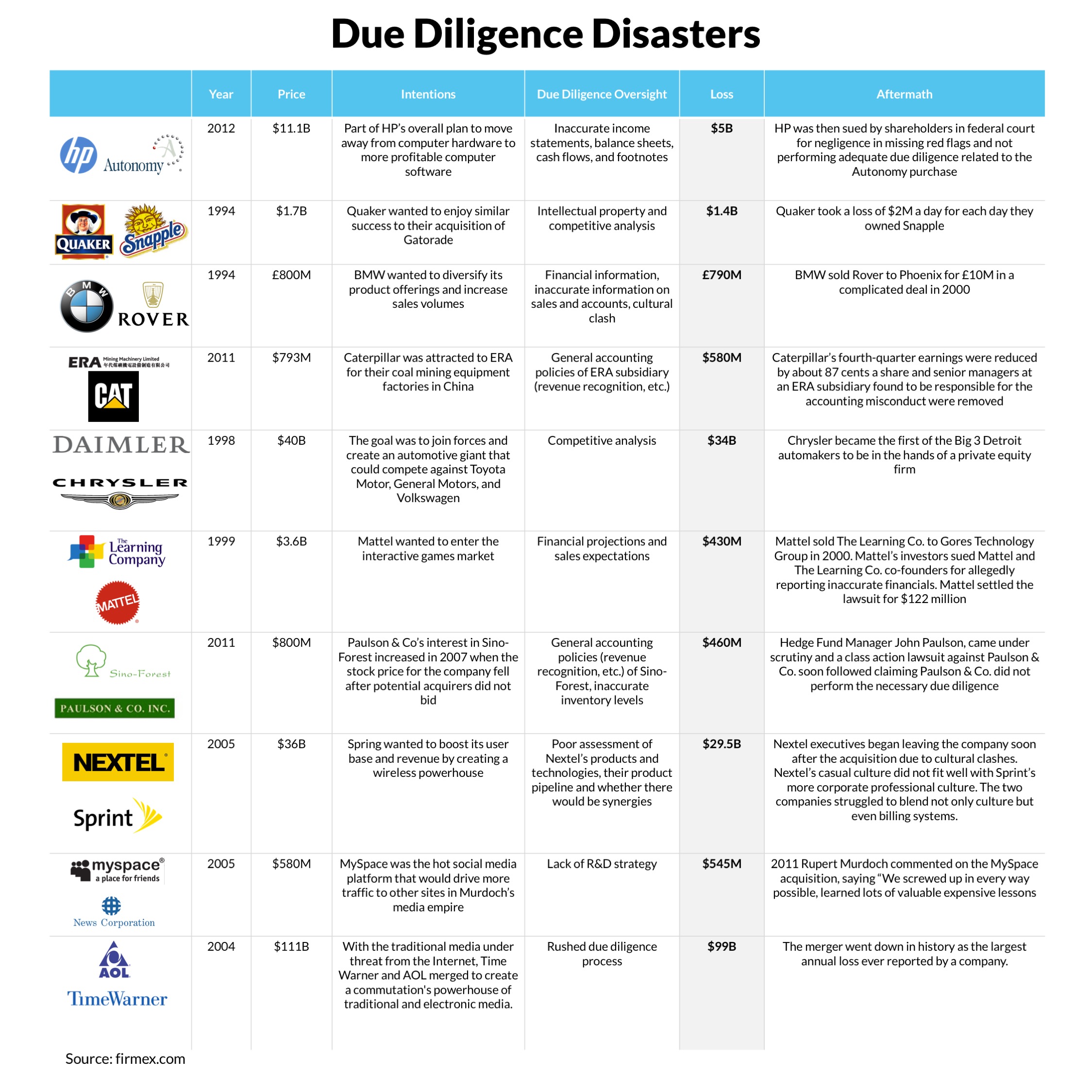
The failure to engage in a complete and effective due diligence process can be catastrophic and result in substantial litigation.
Below is a list describing some of the greatest due diligence failures of all times and some of the consequences that resulted.
ClearThink Capital’s Due Diligence Process
Any due diligence process is based upon organization: the company subject to the review will need to organize its material documents and descriptions of undocumented material facts so as to provide full disclosure in all material respects.
Although most companies can accomplish this process with little disruption, companies that have not kept complete and organized records and documents may be required to dedicate substantial time to establishing an organization process and adhering to the process.
ClearThink seeks to make the due diligence as easy and simple as possible and provides a form of initial due diligence request list that reflects the organization expected by transaction participants and provides a structure for the categorization of documents.
In order to expedite the transaction process and assure full disclosure, ClearThink does the following:
- Dataroom: ClearThink will establish for each transaction an organized dataroom in the form expected by the transaction participants and corresponding to our initial due diligence request list. ClearThink reviews and remediates the due diligence of its client in advance of disclosure to others
- Report: ClearThink will review all due diligence materials provided by its client, as well as other parties to the contemplated transaction, will document its review, and will make suggestions regarding, and endeavor to assist with, remediation, amendments, or explanation required in order to provide full, fair and accurate disclosure
- Gatekeeping: ClearThink will act as the gatekeeper to the dataroom, providing access only with the consent of the relevant parties, thereby minimizing the possibility of the compromise of sensitive data
As a philosophical matter, ClearThink is a strong proponent of full disclosure of both positive and negative information. That being said, proper management of the due diligence process will assure that corrective measures are completed prior to disclosure to third parties, thereby maximizing the probability of a successful transaction.
ClearThink and its principals have extensive experience in the management of due diligence reviews, including reviews relating to 240 public offerings raising an aggregate of $9 billion of public debt and $6 billion of public equity for companies such as The News Corporation Limited, Fox, Comcast, TCI Communications, British Sky Broadcasting, and Liberty Media, among others, as well billions of dollars of mergers and acquisitions.
Planning a corporate or financial transaction? Let’s discuss how we can be helpful. Get in touch with our team below.
These are the two options for a growing company seeking private credit in 2025.
Traditional Banks
While traditional bank financing can be great, emerging growth companies typically cannot obtain traditional bank financing. When a bank reviews a company with high growth, the bank sees risk, but fails to see opportunity. Banks prefer stability to growth, and, as a result, dynamic companies are provided inadequate financing alternatives or no financing at all. In the rare case when traditional bank financing has been made available, it is often insufficient in amount and includes substantial covenant protections, including stringent earnings to fixed charges and financial coverage ratios, and many others.
Learn more about how we assist companies with their credit financings ►
Summary
- Stability over growth
- Restrictive, covenant heavy
- Slow with regard to approval and business development
Private Credit Lenders
Private credit lenders are quite different than traditional banks. Private credit lenders are often family offices or funds that have set aside capital to lend to growing companies. Contrary to traditional banks, private credit lenders enjoy working with high growth companies. They provide flexible financing solutions through ABL, purchase order, invoice, inventory, equipment, term loan, and other forms of credit, as well as merger and acquisition finance. Additionally, as they are typically unregulated, they act substantially more quickly and are more nimble with respect to business developments.
Summary
- Covenant free or light
- Fast approval
- Flexible
- Enjoy working with growing companies
We have been fortunate to meet and develop extensive relationships with a large number of the private credit lenders in the United States. If your company is looking for credit financing, we would love to discuss how we can help you secure the best possible financing for your needs. As ClearThink Capital is generally compensated solely by our client companies and generally does not accept referral fees or commissions from lenders, we, unlike our competitors, are highly incentivized to provide access to credit financing on superior terms with limited or no covenant coverage.